Michigan Masonic Deaths

Between Seeking Michigan (Deaths, 1897-1920) and FamilySearch, Michigan is fortunate to have a robust online presence for vital records research. Factoring in the many outstanding obituary indexes that also exist from across the state, including Grand Rapids, Kalamazoo, and Saginaw, researchers have several fantastic online options when looking for a vital record date.

That being said, the post-1920’s are a particularly problematic era for online genealogy research here in Michigan. First, the statewide death records available at Seeking Michigan end with 1920 (with very few exceptions). Second, although many county-level death records have been indexed and are abstracted at FamilySearch in the database “Michigan Deaths and Burials, 1800-1995,” the impressive holdings there are not statewide, and each county does not contain records during that entire two hundred year time period. Finally, although a number of local societies and county clerks’ have placed indexes to their local records online, including Genesee, Macomb, and Washtenaw, that number is still only a small percentage of the state. Thus, researchers are presented with a significant post-1920 online research gap.

Enter the Masons. Each and every year, dating well back into the 1800’s, the Grand Lodge of Michigan of Free & Accepted Masons held an annual meeting in the state to discuss lodge business, finances, news, and local activities. As with other large fraternal societies, such as the Grand Army of the Republic, a published proceeding documenting the annual state gathering soon appeared. Impressive runs of the annual Transactions of the Grand Lodge of Free & Accepted Masons of the State of Michigan can be found onsite at several research libraries in the state, including the Library of Michigan and the Bentley Historical Library; digital copies of pre-copyrighted years can also be found online at the HathiTrust web site. Buried within each volume is an “In Memoriam” section, which identifies all of the known members of the Michigan masonic community that died in the previous calendar year. Granted, not everyone’s ancestors were Masons, but a significant number were, as the membership statistics would indicate; the 1936 statewide membership was over 123,000. The potential value of these volumes, particularly in the post-1920 time period, should be readily apparent.

However, the Memoriam section is often challenging for genealogists not familiar with their ancestors’ lodge name or number, as the decedent’s names are sorted by lodge number. With more than 500 lodges in existence across the Upper and Lower Peninsulas, scanning through each lodge’s entry represents a significant time commitment.

To make this important resource more accessible to researchers, I have compiled a master index of the deaths that appear in the volume(s), sorted by last name, and posted a PDF of the file here at my web site: genealogyKris. It is also accessible via the home page from the link along the top: “Mich. Masons: Deaths.” Researchers will find the decedent’s name, death date, lodge name, number, and location in Michigan, all important clues for finding obituaries, death records, and much more. Here is a sample entry:

Sample extractions from the Grand Lodge of MI Transactions.

Looking through the Bay City, Detroit, Flint, and Roscommon newspapers around the dates of death should quickly yield obituaries for the men listed in the sample image above.

To date, my site contains more than 2,000 extractions from the 1936 volume, which largely contains 1935 deaths. Additional volumes and years will be added regularly as they are input. Stay tuned!

Local Societies and Their Publications

With the explosion of digital content available at FamilySearch, Ancestry, and other subscription sites, many researchers are left with the impression that an online query at those databases constitutes an “exhaustive” search. Clearly, that is not the case. Researchers that overlook local society publications, print or online, do so at their own peril.

One of my all-time favorite print resources is Hillsdale County Marriage Index: Hillsdale, Michigan, published by the Hillsdale County Genealogical Society. A two-volume set, one for brides and the other for grooms, the resource covers the years 1835-2000; a 2001-2005 supplement is also available. Here are a few entries from the book:

Hillsdale County Marriage Index: Hillsdale, Michigan (2001), p. 598.

Organized in 1835, Hillsdale County is located in southern Michigan on the border with Indiana and Ohio. This means that at the time this resource was published, it included every marriage recorded in the history of the county, a remarkable achievement. With each entry, researchers learn the name of the bride and groom, the year of marriage, and the appropriate liber and page number to be able to find a copy of the county marriage record. What a fantastic resource! I don’t have Hillsdale County ancestors, but I almost wish I did.

The real strength with this resource is the fact that it includes contemporary content, with marriages nearly up to the present day. The large subscription sites may have impressive collections of documents, but in many cases, they do not contain recent records like we see with this Hillsdale County example. We are fortunate here in Michigan, as other examples of local societies indexing their county’s vital records proliferate, including the Downriver Genealogical Society, Flint Genealogical Society, Huron Shores Genealogical Society, Genealogical Society of Monroe County, and a number of others. The critical point is that in many cases, the local society publications often include more recent genealogical information not readily available elsewhere.

One other important point with these society publications is that they often index the county-level records, which in Michigan is a different record than the state-level one; this is an important distinction, as each record set will have a unique citation and source information. I will explore the state vs. county conundrum in more detail in a future blog post.

To find these important society publications, be sure to visit the local society’s web site, the available titles for purchase are always listed. Research libraries, such as the Library of Michigan or the Allen County Public Library, also maintain impressive collections of local society publications.

For many years, local genealogical societies have worked tirelessly to index and make available the records for their respective community. Although more content continues to be placed online, it is important to remember that an overwhelming amount of information will still remain on the ground in courthouses, libraries, and archives. Researchers would be remiss to not utilize the local genealogical society and their publications catalog in the geographic area their family called home.

The Saloonkeeper in the Family

Many genealogists have “favorite” ancestors, those family members that capture our attention with an act of heroism, a heart-wrenching tragedy, a fascinating occupation, or perhaps just an interesting life. That favorite ancestor brings out something in each of us that inspires us, motivating us to learn more about their lives, the time period in which they lived, and the communities they called home.

As someone with an affinity for a good beer, I’ve always been drawn to Frederic Jarand, a saloonkeeper in western Illinois. Born in Gandersheim, Germany in 1825, Frederic Jarand immigrated to the United States in January 1848, arriving in New Orleans on the Campbell. Following a well-worn migration path, Frederic moved up the Mississipppi River and soon settled in St. Louis, Missouri, where he married Amelia Bergfeld in March 1850. The family moved across the Mississippi to Madison County, Illinois for a short time, where a second daughter – Amalia Christina Frederica – was born. In 1856, the family relocated again, this time to Quincy, Illinois, where they remained for many years. Nestled up to the Mississippi River, Quincy is located in western Illinois about 140 miles north of St. Louis and nearly 200 miles southwest of Chicago. A substantial German population lived in the “Gem City,” which no doubt played a role in the Jarand family settling there.

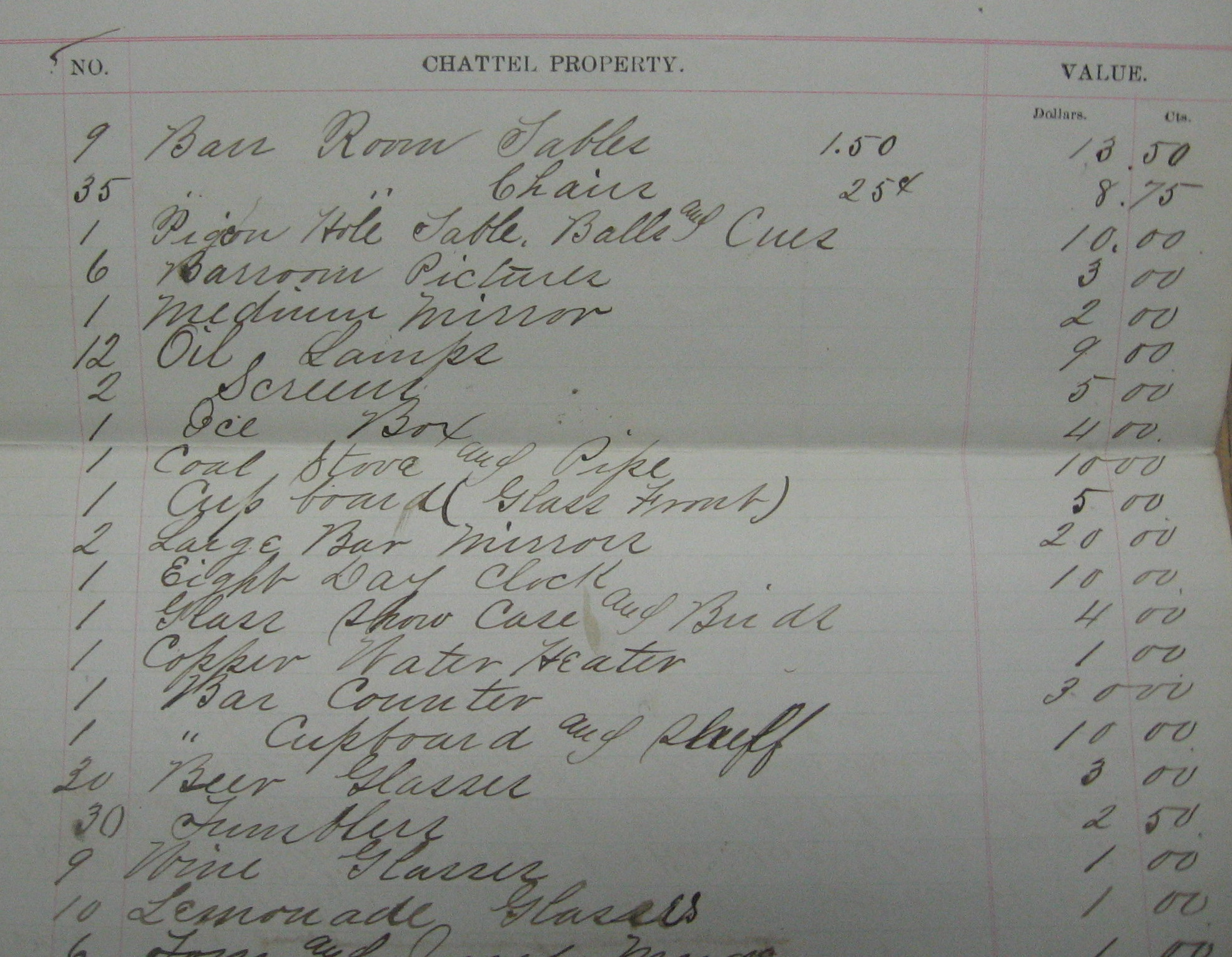
Over the next twenty five years, and at several different downtown locations, Jarand operated a saloon in the city. Following his death in April 1882, Frederic’s probate file includes an estate inventory, which offers an itemized listing of both his saloon and household. Here is an image from one of the pages, detailing several items from the saloon located at the northwest corner of Hampshire St. and N. 6th St. in Quincy.

Frederick Jarand, Estate Records, Box 411, Adams County (IL).

Detailing the beer glasses, tumblers, bar mirrors, tables, and other furnishings, the bar itself, and of course, the wine, whiskey, and other spirits, this estate inventory is one of my favorite documents, one of those “Eureka” moments we all strive for in our research.

Given this inventory, I have a priceless glimpse into Frederic’s saloon, the furnishings, and the equipment he used in the daily operations of his business. Despite the gratifying success with his estate file, I still have much to learn about Frederic Jarand, his town of Quincy, Illinois, and his full-of-spirits profession. That will no doubt cross my mind the next time I visit my local watering hole and order my favorite IPA.


Comparing 1940 with 1930: The Piotrowski’s

Like many of us, I dove right in last week with the release of the 1940 Census, and was excited to quickly find all four of my grandparents: two in Chicago, one in East Chicago, Indiana, and one in Kalamazoo, Michigan. In my family narrative, the 1940 census offers a glimpse into the dynamics of each of my grandparents’ lives, at an important threshold right before their marriages and the outbreak of World War II. Indeed, by the next census in 1950, each set of grandparents will have families of their own, extending the family tree to the next generation.

When I give programs on various genealogy subjects, I almost always use examples of Stanley Piotrowski, my great-grandfather. Not only did he lead an interesting life, but his genealogical paper trail is fascinating and provides a number of fantastic and instructional examples; comparing the Piotrowski’s of 1930 with the family of 1940 is one of those.

In 1930, Stanley and his wife lived on North Street in Kalamazoo, Michigan with their two children, Stella and Francis. Having moved to the city sometime in 1920 or 1921, Stanley worked as a baker and grocer and also became a leading member of the local lodge of the Polish National Alliance. Here is the family in the 1930 Census:

1930 Census, MI, Kalamazoo Co., Kalamazoo, ED-39-15, p. 9A.

Several things jump out with this example, but the most obvious is Stanley’s wife’s name. What is it? Why is it not listed? Her birth name is Wladyslawa (which may explain the enumerator’s reluctance to include it), but the Americanized name was Winifred, a much less challenging exercise. Had I been searching for just Winifred, I would not have had much luck, to say the least. This example illustrates that despite all the technological advances made in family history over the years, the records will only ever be as good as the information found in them. The real puzzler about this 1930 census page is that all of the other family data is accurate, including date of immigration and birthplace, but for whatever reason, the enumerator did not include Winifred’s name. Is there a story there? Did a neighbor provide the information? Perhaps one of the children? Did Stanley or Winifred, but then forget to give her name? Why is the name not listed? I will likely never know.

Moving forward to 1940, we find that not much has changed for the Piotrowski’s. They all still live at the same address on North Street in Kalamazoo, although Winifred is now identified by name; a pleasant change from the 1930 record! One clue not found, however, is the “x” next to the name showing which family member provided the information to the enumerator. That important mark can give the researcher an idea about the accuracy (or inaccuracy) of the information. Given Winifred’s name gap in the 1930 census, I’m not entirely surprised there is no designated “x” with the 1940 record.

1940 Census, MI, Kalamazoo Co., Kalamazoo, ED 39-19, p. 6A.

This is the last census where the Piotrowski family appears together. Francis was killed during World War II, and Stella married in 1943 and started her own family shortly thereafter. Indeed, given the seismic worldwide impact of the coming Second World War, the 1940 Census offers a singular glimpse into thousands of families across the United States, the Piotrowski family included. Although the surviving family members remained in the Kalamazoo area for decades, that Piotrowski line was never all together again on a census page. All of us have similar family stories or tragedies, which makes our 1940 finds all the more compelling.

1940 vs. 1930: Census Release Day

Having been a local history and genealogy librarian for nearly a dozen years, I’ve now experienced “Census Release Day” on two occasions as a professional, first with the 1930 and now with the 1940. I’m not one to get caught up in the first-day mania, but I do get excited with all of the media attention the day brings to our field of study. Coupled with the success of the “Who Do You Think You Are?” and “Finding Your Roots” television series, genealogy and family history has never been as popular or as mainstream as it is today.

As that smiling face behind the reference desk that assists researchers in utilizing the resources, online tools, and various finding aids to locate their ancestors, I’m particularly interested in the first-day experience from the librarian’s perspective. In my experience here in Michigan, the difference between the 1930 census release day back in 2002 and the 1940 release this week is remarkable. I know it’s difficult (or painful) to remember, but life in 2002 didn’t include Facebook, Twitter, Pinterest, Flickr, or “The Cloud.” Think of how quickly information (or misinformation) spreads in today’s world, whether it be new product launches, content updates, or hot topic news. Social media platforms and new technologies have transformed genealogy research in immeasurable ways; our online habits, research strategies, and information sharing today is so much more immediate, widespread, and sophisticated than in 2002. Of all the stories that the 1940 census will unlock for researchers, the most remarkable just might be how genealogists access and share information and how librarians manage those researchers’ immediate expectations.

Back in 2002, researchers arrived at the library looking for and expecting the 1930 census both on microfilm and online. The researcher’s realization that the data was often not immediately available, accessible, or indexed, due to server overload, data upload, or processing time, was sometimes difficult. I recall that Michigan was one of the earliest states put up online, yet many researchers still used the traditional access strategies brought via microfilm. As we progressed through the decade, however, fewer and fewer researchers utilized the films and instead relied solely on the subscription databases; online indexing, however frustrating, coupled with the lack of traditional indexes certainly accelerated this phenomenon.

Yesterday, a number of researchers visited the library looking for and expecting the 1940 census online; microfilm is an afterthought. Michigan may or may not be one of the earlier states put up online this time around, but researchers now will instinctively use online access via FamilySearch, Ancestry, and the National Archives. Today, researcher frustrations now center around overwhelmed servers, time delays with page loads, and unindexed content, not the absence of microfilm. Certainly, we have experienced a sea change in access and research expectations from one decade to the next.

Over the years, I’ve learned that being a reference librarian also means being a coach, friend, drill sergeant, therapist, handyman, and information guru. Teaching and guiding researchers of all levels in this age of instant access has been interesting, to say the least. Helping researchers understand that thousands – millions? – of genealogists just like them are also anxiously waiting to study those same images has forced me to demonstrate some of my hidden reference talents mentioned above.

I’m already looking forward to the limitless possibilities of the 1950 Census release-date on April 1, 2022. How different will genealogy research be then? Think of how our research has evolved in the last 10 years, or even the last 5 years. What an exciting time to be researching family history!

Revisiting Old Photographs

In my research, I came across an impressive collection of family photographs. Certainly a big find, and equally important, it offered me a new project! Many of the photographs were not labeled or identified, so as I scanned the collection, it was important to label everything as best I could, leaving many of the photos with a simple and unfortunate title – “Unknown.” In the field of family history research, is there a more frustrating word?

Once I finished scanning, I was excited to have crossed a project off my to-do list and anxious to start something new, so I never went back and really studied my “Unknown” images. So, I’ve started a new project and made it a point to go back and revisit those photos, and rename or relabel those individuals I can accordingly. There is never enough time in one night to go through the entire set, so I make an effort to do a reasonable number per night, perhaps 5 or 10 images. It will take me a while to go through the collection, but if I identify even a few ancestors in the photographs, it will have been worth it.

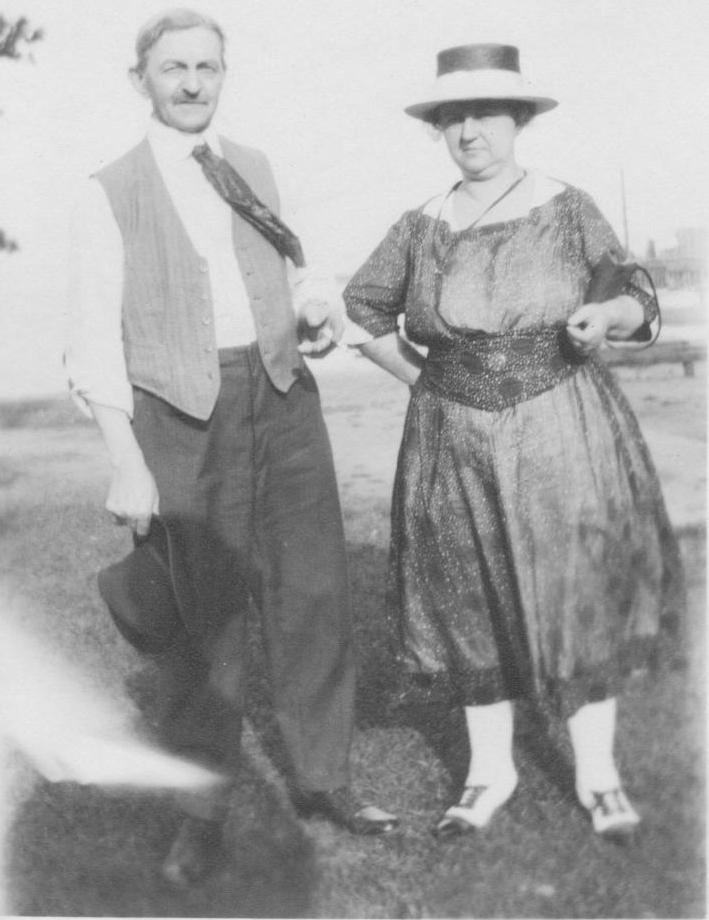
One of my ancestral re-discoveries is this gem of Sophus and Rose Hansen.

Sophus and Rose Hansen, August 1922.

Readers of this blog might remember the Hansen’s from the “Looks As If We Had a Fight Here” post. When I had first scanned this image, outside of the date, there were no identifying marks, so I was unable to determine who the couple was. Indeed, this was one of the first images I had worked with, so although not named in this particular image, they certainly were in different photographs far deeper into the pile. Only by going back and carefully reviewing those images, both the known and unknown, was I able to identify Sophus and Rose and extract them from my pile of Unknown’s.

I’ve been pleased with how many photographs I’ve now been able to identify at least one ancestor in the image. Clearly, something I should have done right away. A lesson learned!

A Dowagiac Interlude

Dowagiac is a small town in Cass County, Michigan in the southwest corner of the state. Located about 25 miles north of South Bend, Indiana, 90 miles east of Chicago, Illinois, and 45 miles southwest of Kalamazoo, Michigan, Dowagiac is perhaps best known as the home of the Round Oak Stove Company, a leading manufacturer of heating stoves in the late 1800’s and early 1900’s.

In my family, Dowagiac plays a brief but important role. After immigrating to the United States from Poland in 1909, Stanislaus (Stanley) Piotrowski settled in Chicago for a short time before relocating to Gary, Indiana. A butcher by trade, Stanley later married Wladyslawa (Winifred) Tobolska in April 1915 at St. Hedwig Church in Gary. Ten months later, a daughter, Stella, was born.

Some time between February 1916 and February 1917, Stanley and his family moved to Dowagiac. I’m still unclear on what brought the family there, but in February 1917, a son was born, John Albert Piotrowski. Tragically, John died of anemia a few months later at the family home at 201 Lagrange Street. Now a grocer, Stanley also became the president of the local branch of the Polish National Relief Committee. According to the 22 February 1917 edition of the Dowagiac Daily News, the group “reports a satisfactory collection of $51.10 which will be sent to the home office at Chicago for the relief of Polish sufferers in Poland.”

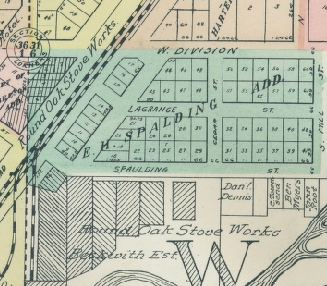
A second son, Francis John, was born in August 1918, and a few weeks later, Stanley registered for the World War I draft, listing the 201 Lagrange Street address as his residence. Here is a closeup image of the Lagrange Street area, as shown in the 1914 Standard Atlas of Cass County, Michigan.

Lagrange St., Dowagiac, from the 1914 Standard Atlas of Cass County, Michigan.

The Piotrowski house is located at the northeast corner of Cedar and Lagrange, Lot 51. Note how close the Round Oak Stove property is to the south. Today, the Lagrange Street property is a vacant lot.

By 1921, the Piotrowski’s had moved to Kalamazoo, Michigan, where they remained for many years. Although Stanley’s time in Dowagiac was brief, no more than 5 of his 87 years were spent there, it was an important interlude for his family’s 50-year story yet to play in Kalamazoo. The Dowagiac interlude saw the birth of two sons, the death of one, a draft registration, and a businessman establish himself in the local community. Perhaps that qualifies as an act all its own.

William the Fisherman

As a child, visiting my grandparents in New Buffalo, Michigan was always something my brother and I looked forward to. Upon arrival, we would run straight to the family photo albums and peruse through the new pictures. My grandmother had the charming tendency to photograph every visitor and/or stranger, whether a carpet installer or grand-child, so there were always new photos to be had!

My brother and I would then spend a lot of time in the lower level of the house, away from our parents’ watchful eyes. Downstairs, now that was where the serious fun was – cards, TV, board games, and the like. In that same room were several paintings, including portraits of my grandparents and one of an unknown fisherman holding his catch of the day. As I got older and became more curious, I learned the fisherman was actually my great-grandfather, William Alderson, and the painting was based on a photograph taken at Gravel Lake, near Lawton, Michigan. Here is an image of the painting on the wall.

Painting of William Alderson, photo taken c. 1966

William Alderson was born in Allegheny County, Pennsylvania in July 1894, joined the National Guard in 1917 and later served in France during World War I, and after returning to the United States, married Julia Kamp in November 1919. Their first child – William, my grandfather – was born in 1922 in Pittsburgh, and the family moved to Chicago soon thereafter. William – the fisherman – died in April 1951 and is buried in Bly Cemetery near Marcellus, Michigan, a short drive from Gravel Lake.

The fisherman painting clearly held a place of prominence at my grandparents’ house, and I regret not talking to my grandfather more about it and his family. Rather, his World War II stories were always more enthralling to me as a youngster.

One can imagine my excitement when I stumbled across an actual photograph of “the fisherman” during a visit with my great-aunt – a particularly gratifying find! Here is the actual photo of William Alderson, showing his catch of the day at Gravel Lake, taken c.1940.

William Alderson, c. 1940.

I’m no fisherman, but that’s an impressive catch….

NGS 2012, Cincinnati

With the attention of the genealogical community focused, understandably so, on the release of the 1940 U.S. Census in just a matter of days, I’d like to write about an equally important event to be held in southern Ohio a few weeks later.

The National Genealogical Society’s Annual Conference will be held this year in Cincinnati, Ohio from May 9-12, 2012. I have the privilege of speaking at this year’s conference – “Michigan Roots: Genealogy Research in the Wolverine State” on Friday, May 11 at 11:00a.

NGS 2012 Conference, May 9-12, Cincinnati, Ohio

In today’s one-click world of Tweets, Likes, and Pins, with instant communication and information sharing, there is still something to be said for attending a national conference, such as NGS or FGS. There is a certain energy and excitement in the air at these events, a hybrid collection of subject experts, content providers, vendors, local societies, booksellers, and attendees, plus new product announcements and content releases, all set against the backdrop of the host city. I’ve experienced this phenomenon recently at NGS 2010 in Salt Lake City and at FGS 2011 in Springfield, IL, and am already looking forward to RootsTech 2013 in Salt Lake City. I expect NGS 2012 in Cincinnati to have that same vibe.

Conferences like these offer attendees limitless possibilities. Myself, I look forward to reconnecting with colleagues and friends, making new friendships, and of course, spending some serious money in the exhibit hall. Let’s not forget about studying the new technological gadget, exploring the latest time-saving solution, and the opportunity to discuss product with the content providers themselves, including Ancestry, FamilySearch, Fold3, and others; as a librarian that works with these products on a daily basis, this opportunity to have a face-to-face conversation is priceless.

One other benefit of these conferences is the opportunity to dive into the local cuisine. As my Michigan and Ft. Wayne friends will attest, I take it as a personal challenge to find the “best” example of the food the host city is known for: the Philly cheese steak, a deep dish Chicago-style pizza, or the horseshoe in Springfield, Illinois. A big fan of chili, I’m particularly excited about the culinary possibilities in Cincinnati; I’m open to suggestions and recommendations!

With a number of the national-level conferences being held recently in the Great Lakes region, including Cincinnati, Springfield (IL), and Ft. Wayne (IN), plus the superb Ohio Genealogical Society Conference held annually, Midwest-based researchers are incredibly fortunate to have these fantastic events so close to home. I encourage everyone to look at their calendars and try to find some time in May to spend with an enthusiastic gathering of family history researchers at the “Gateway to the Western Frontier.”

I hope to see you in Cincinnati in May!

“Looks As If We Had a Fight Here”

One of my all-time favorite family pictures is of my Grandma and Grandpa Alderson, sitting with all of their grandchildren, 5 of us at the time. Taken in the mid-1970’s, I was a young blond-haired toddler. Everyone in the picture, with one exception, has a look of absolute disgust, annoyance, and “I can’t believe I have to sit here for another picture.” My Grandma, on the other hand, looks as if she’d won the lottery, complete with a beaming million-dollar smile. Neither my brother or I remember the circumstances with that photo, but we both just love it.

I am reminded of that Alderson smile-fest when I look at another family gem, this one of a different line in the family. Sophus Hansen was born in Denmark in 1860, and after immigrating to the United States, settled in Chicago. He married Rose Grobner in 1895, and together, they lived at 7042 Kimbark Avenue in Chicago for nearly 50 years. Rose Grobner was born in St. Louis, Missouri in 1878, and moved to Chicago with her family around 1890. Rose died in 1939, Sophus in 1945, and they are buried in Mount Hope Cemetery in Chicago.

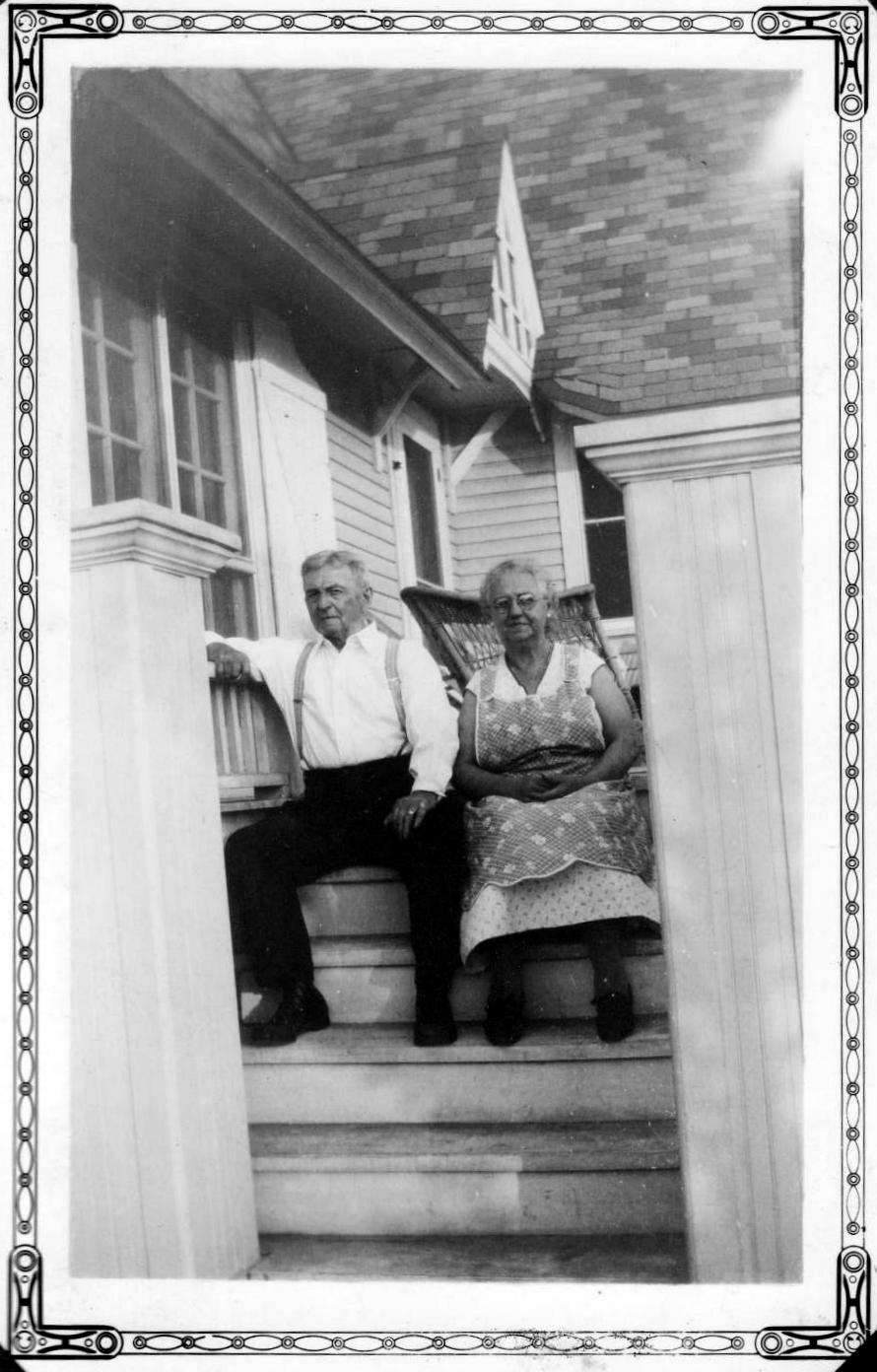
This photo of Sophus and Rose Hansen was taken sometime in the late 1920’s. Their expressions are priceless, and reminiscent of the Alderson photo mentioned above.

Sophus and Rose Hansen, c. late 1920's.

To top it off, there is a caption written on the back of the photo: “Looks as if we had a fight here.” I love it! Based on their body language, Sophus did not fare well in the exchange with his beloved Rose, and she looks particularly delighted with the course of events. Perhaps he “can’t believe I have to sit here for another picture.”