Research Trip Preparations

With my research trip to Chicago coming up later this year, I have a lot of preparatory work to do before I ever set foot in the Windy City.

I prefer to work on one family line or geographic location at a time, not only to help me keep things straight in my head, but also to keep my research focused and streamlined. With my deep ties in Chicago on both sides of the family, I am currently exploring both my paternal and maternal lines during their time in the city, beginning in the 1880’s and continuing on up through the 1950’s. A tall order, to be sure.

Everything starts, however, with my research agenda. Is there a particular ancestor I want to focus on? Is there something specific I’m looking for? What do I hope to find? What things have I looked at already? What gaps do I have in my ancestor’s timeline? How I answer those questions will lead me to particular print resources or online tools as I progress in my research – probate, land, naturalization, church records, directories, etc.

My next step is to explore, from home, online web sites and databases, keeping in mind my answers to those research agenda questions above. FamilySearch, Ancestry, Fold3, and Mocavo are just a few of the sites I explore and constantly revisit to see if any new content has been posted that addresses my research needs. Of particular interest to me is the recent addition at FamilySearch of Archdiocese of Chicago records for dozens of area Catholic parishes.

Despite the wealth of information available online, I still have a number of unanswered questions, which brings me to my next – and favorite – step in my research trip preparations: the library. In addition to my daily access to the Library of Michigan‘s collections (on my lunch hour!), I am fortunate to be a short 2-hour drive from the Allen County Public Library in Fort Wayne, Indiana.

In anticipation of my next ACPL visit, I will spend hours poring through the online catalog, looking for and identifying titles of interest, and then adding their title, author, and call number to an Excel spreadsheet. One of ACPL‘s many strengths is their unparallelled collection of local society journals and newsletters from across the United States, indexed in PERSI. Depending on the family line I’m researching, I often compile an expansive list of journal citations to explore.

As a librarian myself, I encourage patrons to come to the library “armed and dangerous,” ready to attack their research immediately upon arrival. Equipped with their priorities, exact titles, call numbers, and the like, researchers can then quickly find and pull their titles of interest. The key is to spend as little time getting organized once onsite, instead maximizing the limited research time at the library, archives, or clerk’s office. Those researchers that arrive at the library unprepared and without a clear sense of what they’re looking for will likely have a more uneven experience than those that come equipped with a clear agenda and research priorities.

I will arrive at the library with my research agenda and Excel spreadsheet, sorted by call number, and get to work. With my next visit to ACPL coming up in just a few days, I look forward to finding new information and genealogical leads, and in the process better preparing me for my visit to Chicago later this year.

With my new iPhone (my old phone used two cans and a string), I’m playing around with having my research available right on my phone. My research agenda and title list will be right at my fingertips, although I haven’t pulled the trigger on an actual family tree app yet. I suppose that’s something I can write about in a future blog article, so stay tuned!
Russell: A Hat Above the Rest

You have one, probably more. We all do, even if we try and avoid it: the dreaded common surname. Oh, my family has Hansen, Parker, and Thomas – no Smith yet! – but the surname that really gives me a headache is (and no, it’s not Rzepczynski)………Russell.

My Russell of interest lived in Chicago roughly from the early 1900’s until the 1940’s. Do you know how many Russell’s are in Chicago then? Let me tell you – a lot. Despite my misfortune with a common surname in one of the biggest cities in the country, I am incredibly fortunate, because my ancestor has that fantastic gift that we all hope and pray for – a unique first and middle name.

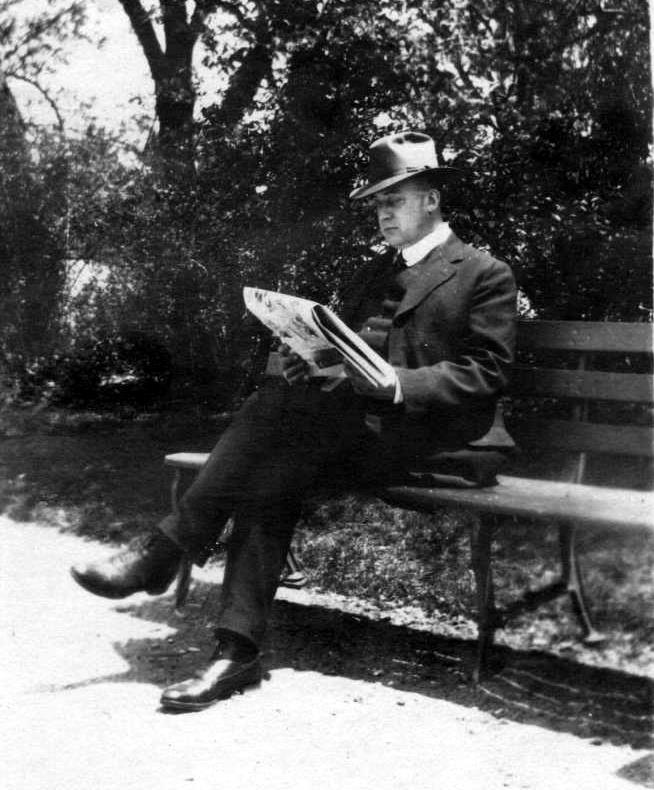
Meet Fenton Harvey Russell, my great-grandfather. Born in Toronto in 1883, he immigrated to the United States in 1909, settling in Chicago. Here is Fenton in May 1919 at a local Chicago park.

Fenton H. Russell, Chicago, 1919.

I’d like to think he’s reading the sports page, dissecting the White Sox box score, or perhaps looking at the Marshall Field’s ad for men’s hats. Most images of Fenton that I have show him wearing some stylish hat, and this photograph is no exception; he certainly wears it well.

Fenton joined the Masonic fraternity soon after he arrived in Chicago (Garden City Lodge No. 141), trained as an architect by profession, and became a U.S. citizen in 1922. He died in 1947 and is buried in the family plot at Mount Hope Cemetery in Chicago.

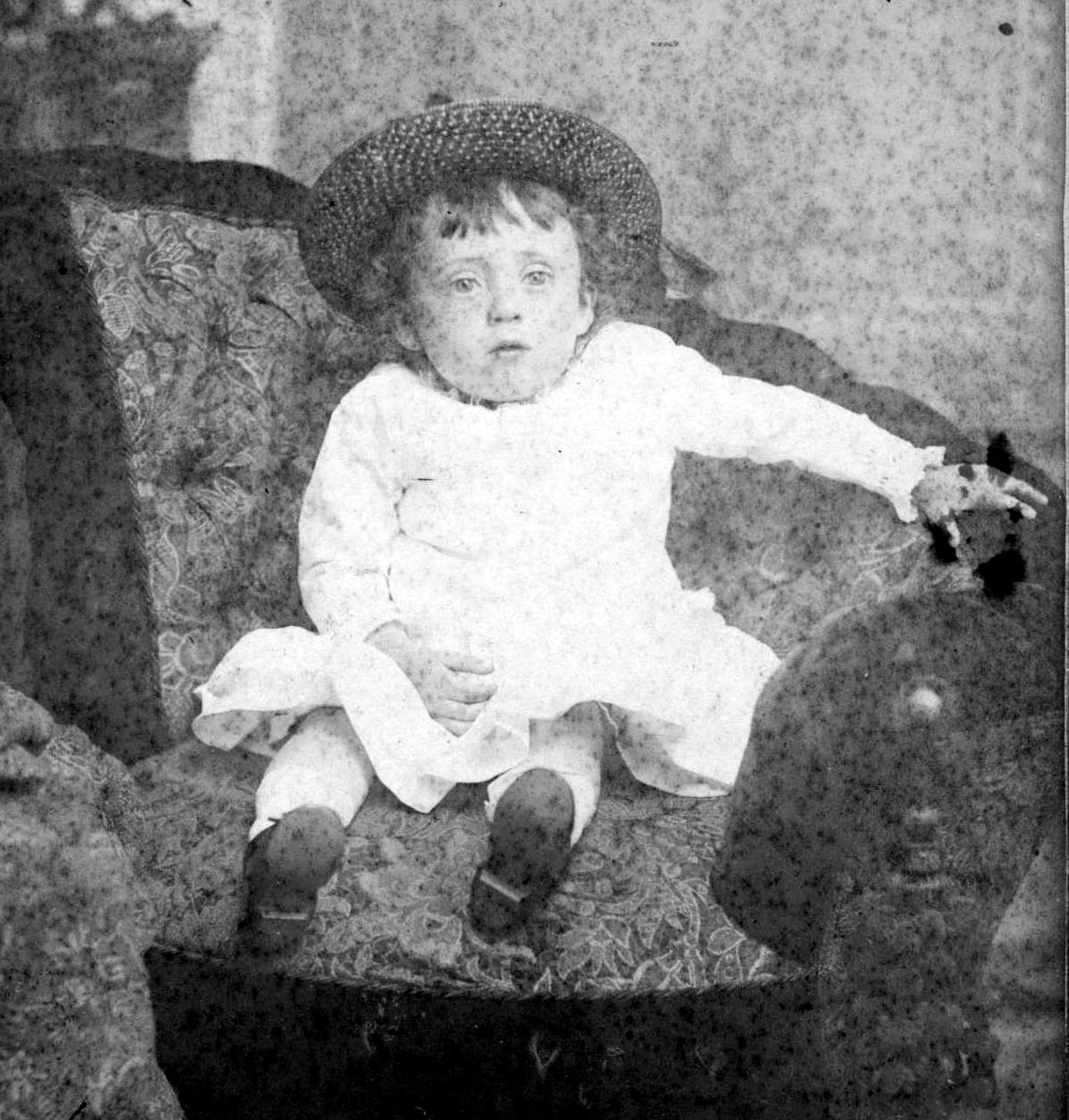
Here is another picture of Fenton, taken while still a youngster in Toronto. His distinctive face really stands out, as does the nice hat. He wears the hat well here, too, even as a young boy. I love this picture, one of my favorites.

Fenton H. Russell, fashionable since 1883.

In my research on Fenton, I’ve been incredibly fortunate. Despite living in one of the biggest cities in the United States, there is only one – and a stylish one, at that – Fenton Harvey Russell. If I ever need a reminder how challenging and frustrating those common surnames can be, I need to look no further than Fenton’s own parents – Henry and Mary Russell. Unique first names, they are not…..


Sweet Home Chicago

Growing up in southwestern Michigan, Chicago was always the big city my family looked to for shopping, dining, museums, and the overall urban experience. My parents often pointed out certain South Side landmarks to my brother and I in the back seat as we sped (or crawled) by on the Skyway en route to some downtown destination. So, although I certainly recognized that my family had origins in the Windy City, I did not truly appreciate the impact Chicago had on my own life until I really began to explore my family history.

At some point in their lives, all eight of my great-grandparents lived in Chicago, all but two of them during the 1909-1915 time period. Ironically, those two great-grandparents not in the city then were the family I always associated as being “old Chicago,” when in fact, they were the most recent arrivals in the early 1920’s.

Later this year, I’ll be spending an extended research trip in Chicago, exploring libraries, archives, museums, clerks’ offices, churches, cemeteries, and more. Given my deep roots in the city, my research “To-do” list is already substantial, and will only continue to grow in the weeks leading up to my trip.

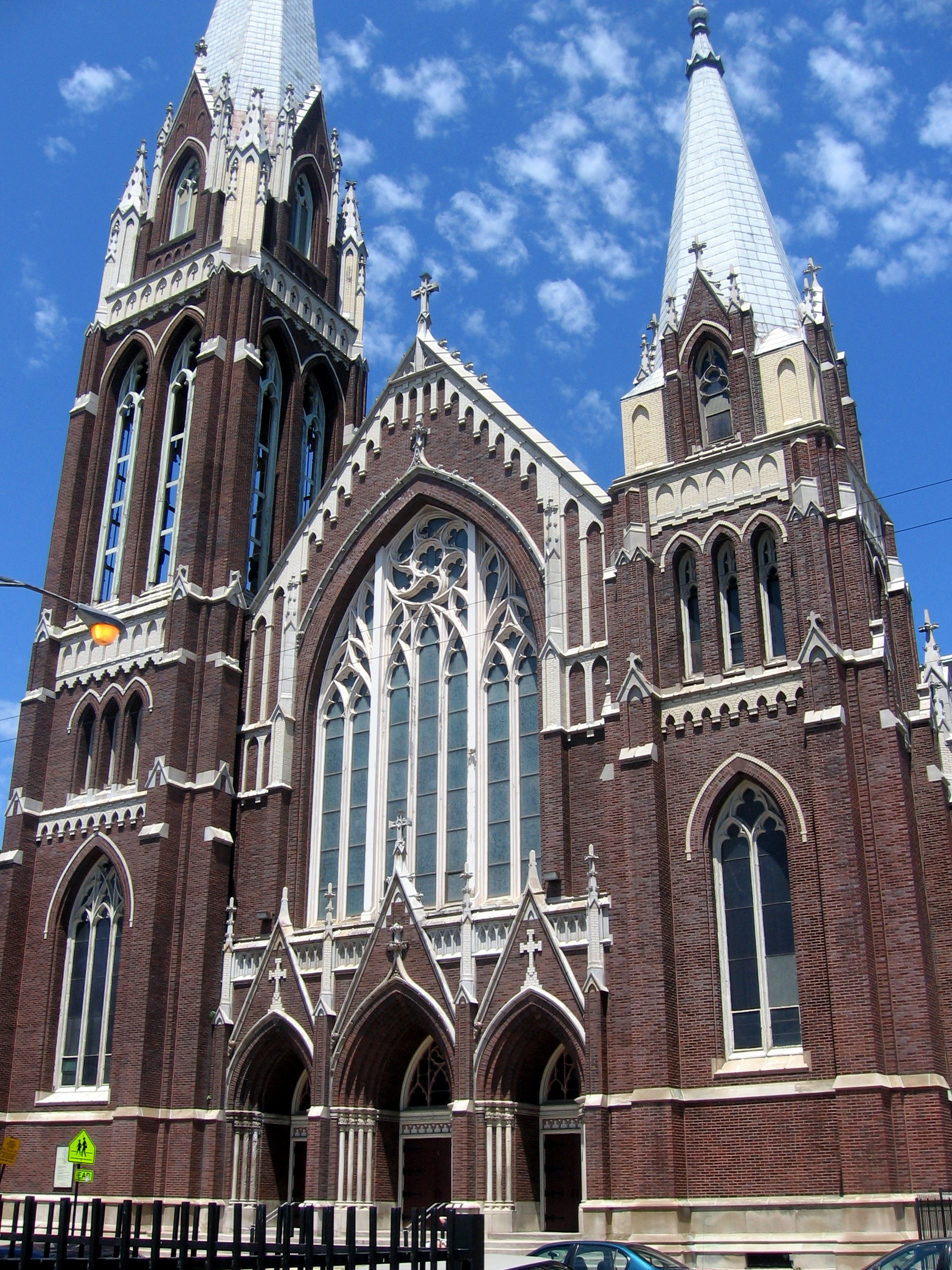
Here is an image from a previous day-trip into the South Side, St. Michael Church at 83rd and South Shore Drive. One of the more visually striking churches I’ve ever seen, this church was where my great-grandfather Leo Stempkowski married Helena Zdzarska in January 1914.

Over the next few months, some of my blog posts will explore my research preparations, lessons I’ve learned from previous trips (including Pittsburgh, Salt Lake City, and western Illinois), what I hope to find on this one, and much more.

One of the things I’m most looking forward to is the time I’ll spend with my brother in the evenings, after all the libraries and research rooms are closed. Since he lives in the area, we’ll have an opportunity to spend quite a bit of time together, more than we’ll we’ve had in years. I expect there will be some outlandish family stories exchanged, many of them starting with “Do you remember when….?” A perfect way to wrap up a day of spending time with the family….


X Marks the Spot

As a local history librarian, I have worked very closely with the Death Records, 1897-1920 collection available online at Seeking Michigan. Totaling nearly 1 million certificates, this collection covers a critical period in Michigan’s history, the point where the state became the worldwide epicenter of the automotive industry. Drawn by the lure of steady work and wages, thousands of families migrated to Michigan from all over the United States and around the world.

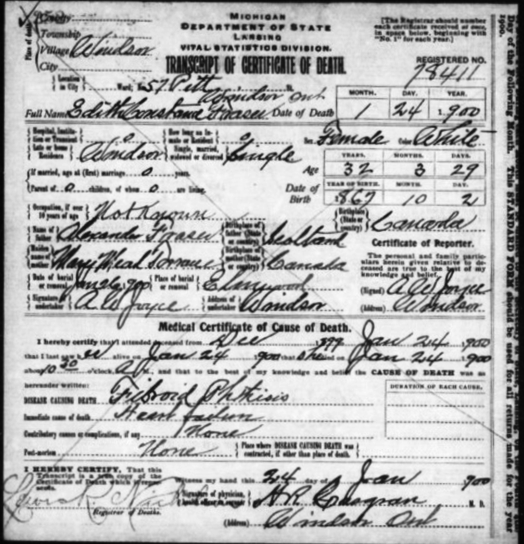
As a family history researcher, I am particularly fascinated with off-the-beaten path records, those unintended, peculiar, or otherwise accidental certificates. One terrific example at Seeking Michigan is Edith Constance Fraser, who died in Windsor, Ontario on 24 January 1900. Born in Canada in 1867, Ms. Fraser was the daughter of Alexander and Mary Fraser, and was buried at Elmwood Cemetery in Detroit on 26 January 1900.

Edith Fraser death, 24 January 1900, Wayne County, MI

So what is an Ontario death doing amidst a collection of Michigan records? The large “X” across the certificate indicates that the record is invalidated, suggesting that a true “official” record exists elsewhere under a different jurisdictional authority; in this case, Ontario, Canada. For whatever reason, a Michigan record was filed under Wayne County for Ms. Fraser, perhaps because the burial took place in Detroit. In the recent past, finding this example would have been next to impossible, as the existing indexes only included valid certificates; today with online access, researchers can easily find any certificate in the collection, whether an official record or one branded with an “X.”

Now let’s explore the corresponding “official” Ontario death record for Edith Fraser.

Edith Fraser death, 24 Jan 1900, Essex County, ONT (009289)

This record not only reinforces some of the data gleaned from the Michigan certificate, but also offers new information, including Ms. Fraser’s residence in Essex County and her religious affiliation. All good material, but more important is what is NOT shown – parents’ names, cemetery, name and address of undertaker, and date of burial – information all provided on the Michigan record.

When comparing the Michigan and Ontario records side by side, although each provides unique information, one can argue that the Michigan record offers far more genealogical value than the Ontario one. The point here, then, is that in some cases, there may be a second – and possibly quite different – record; this would be true particularly with families near a county, state, or international boundary, or ancestors that are buried in a different location than where they lived. The invalid or “X” record may provide important fields of data, such as parents’ names, that the official certificate does not. Depending on the state and time period, then, perhaps the accidental record is superior to the official one, much like the Edith Fraser example above.

Other out-of-state examples abound in Seeking Michigan, including death certificates from as far as Oakland, California, St. Louis, Missouri, and Cleveland, Ohio. In the case of Edith Fraser, a genealogy researcher would be delighted with her paper-trail legacy of dying twice. Each record provides unique insight into her life and family, while simultaneously opening new avenues of research. What more could one ask for?

A missing Kamp

With the release of the 1940 Census now less than 40 days away (!), many researchers are anxiously awaiting the opportunity to explore the records, make new discoveries, and reconnect with lost ancestors.

In my research, there is one couple I am particularly anxious to reconnect with. Frank and Mary Kamp lived in Washington County, Pennsylvania (about 15 miles south of Pittsburgh) at the time of the 1920 Census. Here is the Kamp family in 1920: Frank, Mary, Albert, Jane, and Julia with her husband William Alderson.

The Kamp family, 1920 Census, Peters Twp., Washington Co., PA (ED 209, p. 2B)

Following that enumeration, however, I have been unable to find evidence of either Frank or Mary in any records. By 1930, their son Albert had moved to California, daughter Jane had remained in the Pittsburgh area, and daughter Julia had moved to Chicago. Yet Frank and Mary have continually evaded detection and proven to be my genealogy kryptonite.

The one question from the 1940 Census that I’m most interested in is the “In what place did this person live on April 1, 1935?” query. Think about the value of that question! Given the post-1920 gap in my research, this question could unlock the mysteries surrounding my Kamp research.

Over the years, I’ve had several promising leads and a few educated guesses about Frank and Mary’s whereabouts in 1930 and beyond, but nothing has ever panned out. I’m hoping that, if still alive then, they will represent my first 1940 Census research triumph. Here’s hoping the 1930 Kamp mystery will finally be solved a decade later!

Intersecting Ancestors

Our family narratives are full of fascinating stories of heroism, romance, joy, tragedy, and so much more. These dramatic tales become even more compelling when our ancestors’ lives overlap at unexpected moments, events, or places across generations. In my family, one such intersection occurred before and during World War I, in the deep waters of the Atlantic Ocean.

Stanislaus Piotrowski, my paternal great-grandfather, immigrated to the United States aboard the liner S.S. President Grant, arriving at Ellis Island on April 15, 1909. Originally from Kolo in Russian Poland, Piotrowski lived briefly in Chicago before getting married and starting a family in Gary, Indiana. Here is a snip from his arrival record, showing his name, age, and occupation.

Closeup of Stanislaw Pietrowski arrival record at New York, 15 April 1909.

The President Grant was constructed in 1907 in Belfast, Ireland, and served the Hamburg-America Line for several years until the outbreak of the First World War in 1914. Here is a picture of the ship taken in 1919, courtesy of the U.S. Naval History and Heritage Command.

USS President Grant, c. 1919

The President Grant remained in New York until the United States entered the war, was then transferred to the U.S. Navy, and during the course of the war, ferried nearly 40,000 troops through the treacherous waters of the Atlantic Ocean and to the European battlefields.

William Alderson, my maternal great-grandfather, enlisted in the Pennsylvania National Guard in April 1917. Originally from Mount Lebanon, Pennsylvania (just south of Pittsburgh), Alderson served overseas during World War I, largely in Paris with the Finance Division of the Ordnance Department. The 19 February 1918 excerpt from Alderson’s diary, written aboard the USS George Washington during his Atlantic voyage en route to France, reads: “I awoke this morning at 6:45, dressed, I went to the deck to see the ocean, there was no land in sight….All I could see was water on every side and the water was rough….There is seven other ships besides our own, three of them are the, DeKalb, Pres. Grant and Pres. Lincoln, they are very good ships and carrying soldiers on board. It is estimated that 30,000 troops on board the ships and it some of the ships are carrying mules and cargoes of supplies.”

What a great story! The ship that carried one great-grandfather to the United States was in the same troop convoy that brought another great-grandfather back over to Europe to serve his country. I never anticipated that Piotrowski-Alderson would overlap as they did; indeed, nearly 50 years after the President Grant intersection, Stanislaus Piotrowski’s grandson would marry William Alderson’s granddaughter, linking the families together on the pedigree chart.

As my research continues, I look forward to discovering new connections, remote or otherwise, in my family’s journeys through the generations.

“Removing” the 1890 Gap – City Directories

One of the big thrills of research is the unexpected information revealed in unexpected places. City directories remain one of my favorite sources, but they are of particular value during the 1890 gap, that time period of frustration for many of us; with the loss of the 1890 Census, researchers are often left with a wide 20-year chasm in their research, during a critical period in American immigration, industrial, and social history.

Treasure troves of fantastic local historical information, including listings of local business, Grand Army of the Republic posts, public buildings, cemeteries, churches, ward boundaries, street guides, schools, advertisements, fraternal societies, and, of course, names, directories can place residents in urban communities, usually on an annual or biennial basis. Many of the directories from across the United States, roughly between 1861 and 1921, can be found online at the subscription database Fold3.

Each named entry typically includes an address, occupation, and in some cases the name of a deceased spouse. In addition to the important information above, directories for certain (not all, unfortunately) cities also include death dates for the recently deceased. Here is an example from p. 1298 of the 1890 directory for Boston, published by Sampson, Murdock, & Co.:

Bernard H. Vandenacker, 1890 Boston city directory

Other cities that have this death date information, and there undoubtedly are others, include Detroit (MI), Grand Rapids (MI), Jackson (MI), Minneapolis (MN), Providence (RI), and Toledo (OH).

Perhaps more revealing than the death information, however, are the “Removed to” entries found in the same directories, which show where residents have relocated to, whether it be a neighboring county or a far-away community across the country. Given the wide timeline gap presented by the loss of the 1890 Census, identifying that an ancestor moved, and where, is of great importance.

Here is a snip for a Miss Julia Bell from p. 77 of the 1890 Jackson, Michigan city directory, published by R. L. Polk.

Miss Julia R. Bell, 1890 Jackson (MI) city directory

For Miss Bell, who perhaps had married by the 1900 Census, this directory offers a vital clue for a researcher tracking down her whereabouts during the 1890 time period. Chicago is a good distance from Jackson, and knowing where to focus the research is critical to success. Using the directories from the cities listed above, perhaps you, too, can find those unexpected clues in familiar resources.

“Left County” for Chicago

One of my enduring research mysteries had always been the Grobner family during an 8-year window in the late 1800’s. Living in St. Louis, Joseph and Frederica Grobner seemingly vanished in 1882 until they reappeared in Chicago around 1890. Their three eldest children – including my g-g-grandmother Rose Grobner – were all born in St. Louis, and two other children were later born in Illinois. I’d always presumed that meant Chicago, since the family eventually lived there for decades, but I was unable to locate them in the Windy City during that important 8-year window.

Everything came together last year. In planning a fall research trip to Quincy (IL) to further my research on Frederic Jarand (Frederica Grobner’s father), I discovered the Quincy Public Library’s outstanding database of early Quincy newspapers. In full digitized glory, I found piles of information on Frederic Jarand……..and Joseph Grobner and his wife Frederica. Success!

Using the Quincy newspapers, city directories, probate files, tax records, and more, I’ve now been able to glimpse into that 8-year window before the Grobner’s eventual arrival in Chicago. After her father Frederic died in 1882, Frederica and Joseph Grobner relocated to Quincy from St. Louis to take over her father’s saloon. Financial difficulties perhaps played a role in the family later relocating to Chicago around 1890.

"Left County" for Chicago, 1890 Quincy IL tax records

The image here shows a snip from p. 53 of the 1890 Quincy tax records (held at the Gardner Museum of Architecture & Design). The entry for Mrs. F. Grobner clearly shows “Left County,” and their residence at 1254 Kentucky. Joseph Grobner appears in the Chicago city directories shortly thereafter, bringing a gratifying conclusion to one of my many research mysteries.

Harrison Park, Kalamazoo MI (My first blog post!)

I grew up in Kalamazoo, Michigan, and over my 20+ years living there, I drove past Harrison Park thousands of times. Located on the northeast edge of town, the small triangular-shaped park is in what was the city’s Polish neighborhood. Growing up, I remember my Dad pointing out several buildings in the neighborhood that tied back to the family.

A few years ago, my Dad mentioned that there was a monument at Harrison Park, dedicated to the fallen men of World War II, Korea, and Vietnam that were from that neighborhood. With two ancestors that were killed during World War II, my curiosity was piqued.

My next visit to Kalamazoo included a stop at Harrison Park, and sure enough, there was the monument. Among the men listed were Francis Piotrowski (1918-1944) and George Topoll (1918-1943), my ancestors.

Harrison Park monument, Kalamazoo (MI)Discovering the monument was certainly important, but the big find was the lodge number and name of the Polish National Alliance (#2144, White Eagle Society), the fraternal group that dedicated the monument as a memorial to those Polish men who had died during the war. Francis’ father – Stanley, my great-grandfather – was very active with the PNA, and I now had identified the lodge he’d been active with.

I’d driven past Harrison Park thousands of times over the years, but had never noticed the monument, its historical significance, nor its important genealogical value. I had been so focused on the names and dates on my family tree, learning as much and as quickly as possible, I had failed to take a step back and explore the historical context of my ancestors’ lives – the neighborhood they called home, the parks they played in, and the national events that shaped their lives. I had nearly missed a vital piece of my family’s story in the old neighborhood. A lesson learned!